> ## Documentation Index
> Fetch the complete documentation index at: https://docs.percify.io/llms.txt
> Use this file to discover all available pages before exploring further.
# Make an avatar copy the motion in a video
> Motion Sync takes a video as the motion source and an avatar image, and generates the avatar performing the same movement. Priced per second of video.
Motion Sync drives an avatar with the movement from a video you supply. Upload or record a clip as the motion source, pick the avatar image, and the avatar performs the same movement. Open it at [app.percify.io/home/motionSync](https://app.percify.io/home/motionSync?utm_source=docs\&utm_medium=referral\&utm_campaign=create-motion-sync).
 ## How to run one
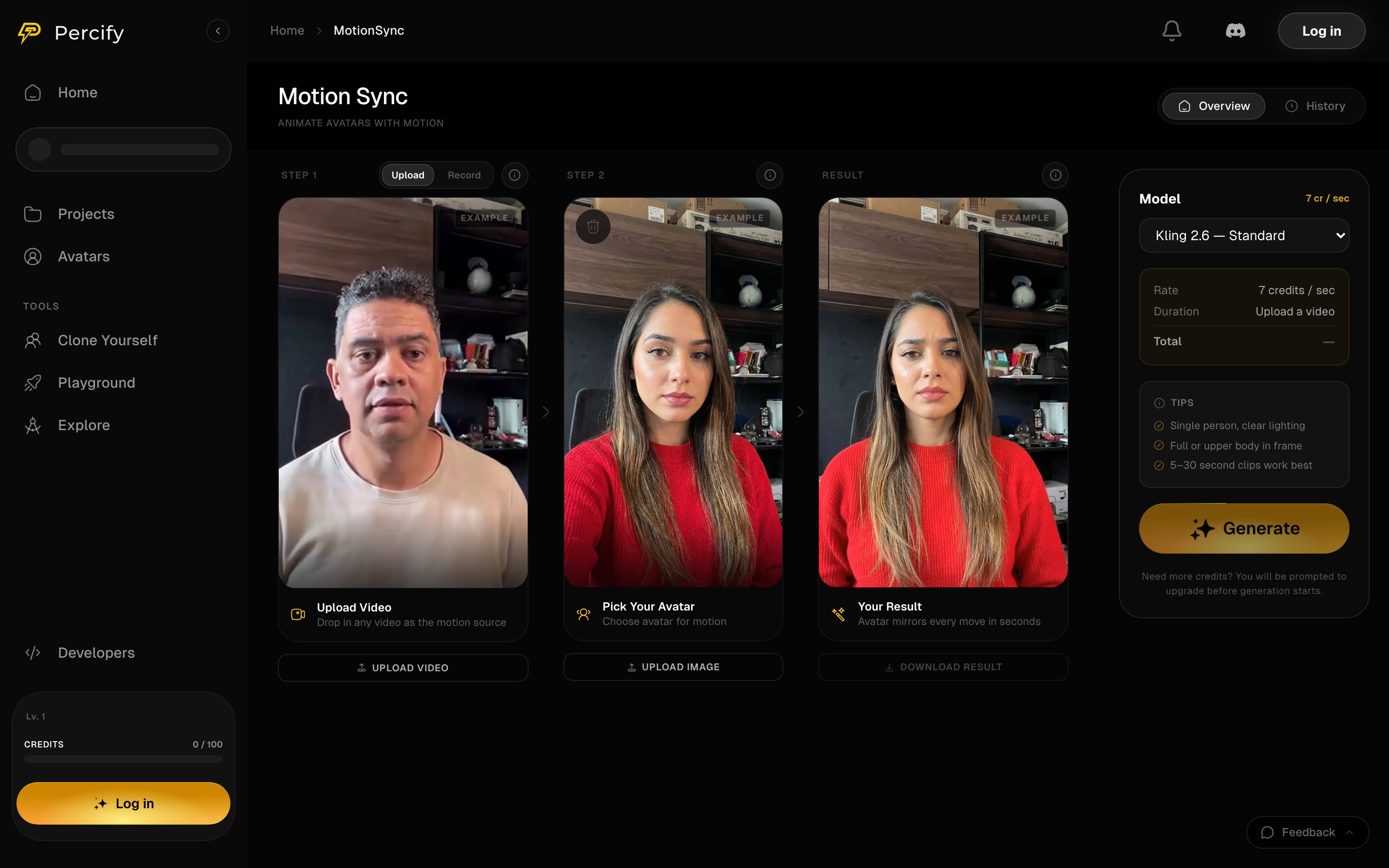
1. **Step 1** Upload a video as the motion source, or press **Record** to capture one.
2. **Step 2** Upload the avatar image that should perform the motion.
3. Pick the model. **Kling 2.6 Standard** runs at **7 credits per second**.
4. Press **Generate**. The panel shows Rate, Duration and Total, so the price is settled before the run starts.
Because it is priced per second of the source video, the length of the clip you upload is what decides the cost.
## What works best
The tips on the page are worth following:
* One person, clearly lit.
* Full body or upper body in frame.
* **5 to 30 second clips** work best.
A crowded frame gives the model more than one body to track, and a very long clip multiplies the cost without improving the result.
## FAQ
Per second of the source video. Kling 2.6 Standard is 7 credits a second, so a 10 second clip is 70 credits. The Total line shows the figure before you generate.
5 to 30 seconds. Shorter clips cost less and hold together better.
Yes. Step 1 has a **Record** tab beside **Upload**.
Lip-sync animates a face to match audio. Motion Sync copies body movement from a video. See [Lip-sync a photo to any audio](/create/lip-sync).
## Related
Animate a face to speech instead of to movement.
Rebuild a whole video shot by shot with your own cast.
Clip lengths and credit prices, grouped by what they make.
Credit prices across the app.
## How to run one
1. **Step 1** Upload a video as the motion source, or press **Record** to capture one.
2. **Step 2** Upload the avatar image that should perform the motion.
3. Pick the model. **Kling 2.6 Standard** runs at **7 credits per second**.
4. Press **Generate**. The panel shows Rate, Duration and Total, so the price is settled before the run starts.
Because it is priced per second of the source video, the length of the clip you upload is what decides the cost.
## What works best
The tips on the page are worth following:
* One person, clearly lit.
* Full body or upper body in frame.
* **5 to 30 second clips** work best.
A crowded frame gives the model more than one body to track, and a very long clip multiplies the cost without improving the result.
## FAQ
Per second of the source video. Kling 2.6 Standard is 7 credits a second, so a 10 second clip is 70 credits. The Total line shows the figure before you generate.
5 to 30 seconds. Shorter clips cost less and hold together better.
Yes. Step 1 has a **Record** tab beside **Upload**.
Lip-sync animates a face to match audio. Motion Sync copies body movement from a video. See [Lip-sync a photo to any audio](/create/lip-sync).
## Related
Animate a face to speech instead of to movement.
Rebuild a whole video shot by shot with your own cast.
Clip lengths and credit prices, grouped by what they make.
Credit prices across the app.